Does Quantum Mechanics Undermine Materialism? Part I: Determinism, Free Will, and the First Cause
A response to physicist Stephen M. Barr, with additions

Introduction
I recently read a paper by the Catholic theoretical particle physicist and Professor Emeritus of Physics at the University of Delaware, Stephen M. Barr, titled Does Quantum Physics Imply that Materialism is False? on the philosophical implications of quantum physics. It was published in 2025 to coincide with the hundredth anniversary of the discovery of quantum mechanics. I encourage you to read his work directly. My main reason for writing is, beyond presenting my own thoughts, to draw attention to Barr’s writing, which I think deserves a wider readership. I ask the reader to at least take the trouble to read Barr’s work, even if you find mine unsatisfactory!
I am responding more directly to Chapter 20 of his book Modern Physics and Ancient Faith, which I first read several years ago and re-read recently, in which he argues that quantum mechanics is incompatible with physical determinism and philosophical materialism — philosophies that leave no room for free will or the mind as a spiritual entity that knows and desires. He goes further, arguing that quantum physics is consistent with the traditional Catholic understanding of free will as something capable of initiating thought without a physical or material cause.
This is the first of two articles. The second takes up the more speculative questions raised by Barr’s “traveling minds” hypothesis in his essay — his proposed alternative to the Many Worlds Interpretation of quantum mechanics — and explores two further arguments of my own: that divine omniscience resolves a problem about objective reality that quantum mechanics raises but cannot on its own terms answer, and that the classical Thomistic account of beauty, approached from an entirely different direction, points independently toward the same conclusion. The second article also contains a fuller explanation of the physics, including an account of the mathematical foundations of quantum mechanics and Heisenberg’s (one of the pioneers of quantum mechanics) striking use of Aristotle’s concept of potency and act to describe the quantum state (in ways that I hope non-mathematicians - of whom I am one - can understand). I encourage readers who want that background before proceeding here to consult Barr’s book and the article referred to above.
My thesis in this post is this: Barr is right that quantum mechanics rules out physical determinism and is incompatible with materialism, and right also that this opens a genuine space for free will understood as a non-physical cause acting in the physical world. But I think his argument, which focuses on the human brain and the human mind, does not go far enough. Quantum indeterminacy is universal. Most quantum events in the universe have nothing to do with the human mind at all, and it seems to me that something must be selecting those outcomes, too. I want to suggest that this is God, understood in the tradition of Aristotle and Aquinas as the First Cause and Unmoved Mover — the intelligence that continuously sustains every event in creation. This is not, I should stress, a God-of-the-gaps argument of the kind materialists rightly criticize, in which God is invoked to fill a hole that science might eventually close. The gap I am pointing to is one that physics (or quantum physics at least), by its own account, tells us cannot be closed from within physics. That distinction matters, and I return to it below.
I should say at the outset that I am very much an amateur in both physics and philosophy. I studied materials science at university many years ago and covered quantum mechanics as part of my degree, though I was never the best student in the room. I offer what follows as speculation, and I invite those better qualified than I am to raise any objections I have not anticipated.

What Quantum Mechanics Tells Us
Quantum mechanics is the branch of physics that describes the behavior of matter and energy at the very smallest scales – the scale of atoms and the particles from which atoms are made. It has been tested with extraordinary precision for a hundred years and has never been found wrong. Everything in the physical world, at its most fundamental level, is governed by it.
The central and deeply strange feature of quantum mechanics, for the purposes of this article, is this: at the level of individual particles, physics can only tell us the probability that something will happen, never that it definitely will or when. Consider a radioactive atom. Quantum mechanics can tell us that, for example, there is a 50% chance it will decay within a given period. What it cannot tell us is whether this or that particular atom will decay or when it will decay. No physical measurement, however precise, and no refinement of the theory can supply that information. It is not that we lack the tools; it is that quantum mechanics itself tells us the answer is genuinely indeterminate. Only the probabilities are fixed; the individual outcome is not.
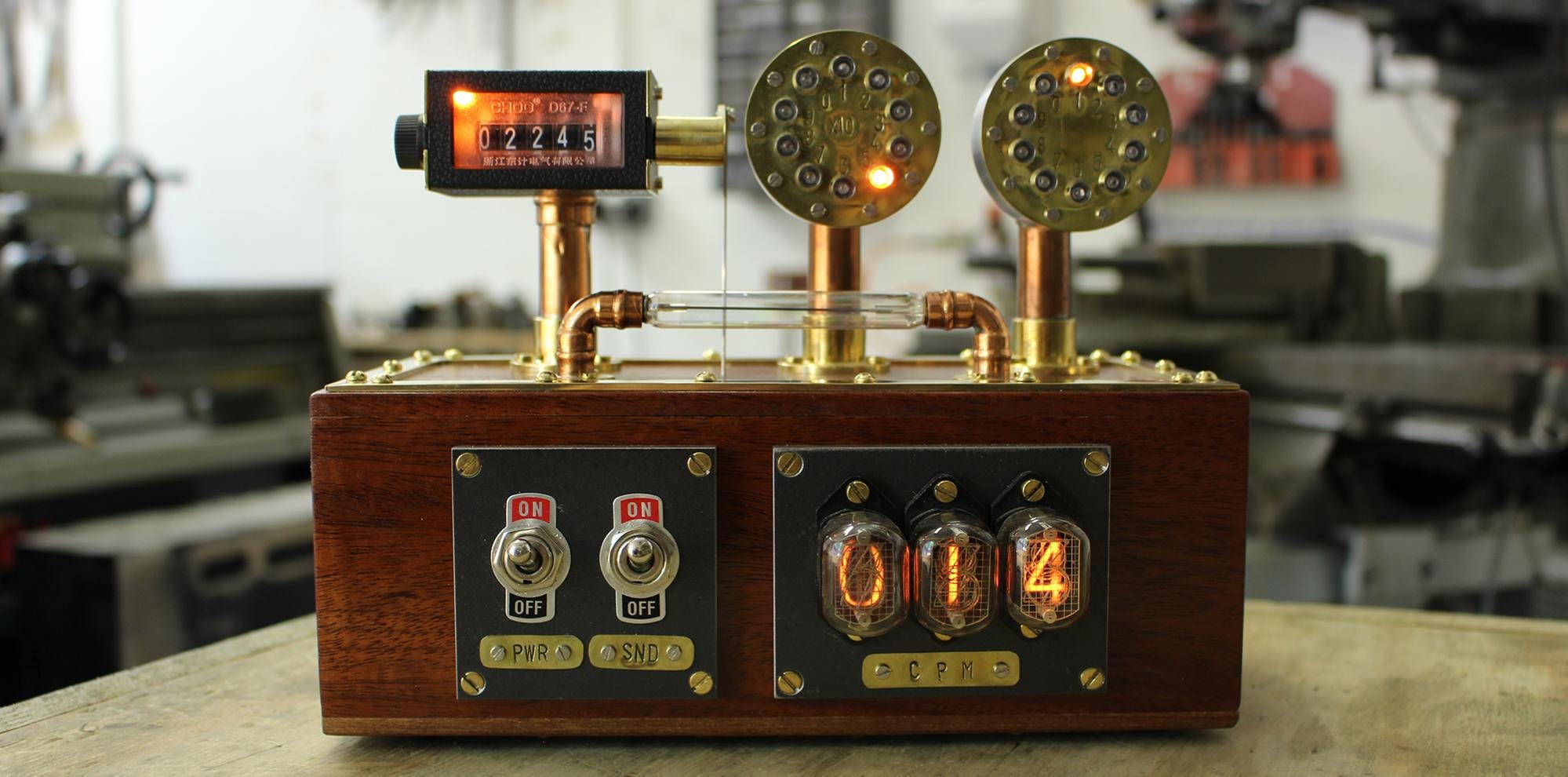
This is deeply counterintuitive because it is not how physics behaves at the scale we can see and touch. At the level of everyday objects – billiard balls, bridges, and planets – classical Newtonian physics holds, and outcomes are in principle fully predictable from prior causes. It is mysterious that a world of individually unpredictable quantum events gives rise, at larger scales, to the orderly, predictable world of classical physics. That transition is one of the genuinely unsolved puzzles of modern science. I remember in high school being struck by how strange it was that, from a simple statement of the probability of radioactive decay, we could so easily calculate the half-life of the whole sample - the time it takes to reduce by half - and the smooth graph for the predicted pattern of decay of that sample of trillions and trillions of atoms could be generated. For our purposes, the key point is simply that at the most fundamental level of physical reality, there is genuine indeterminacy – a causal gap that physics itself cannot close because of the pattern of decay at the level of individual particles is mathematically inconsistent with a physical cause (the second article explores the nature of the pattern of this mathematics that reflects this in more detail).
Quantum Indeterminacy and Free Will
Barr makes a further argument that follows naturally from this. Because quantum events are irreducibly probabilistic — because no physical cause determines their outcomes — the physical processes underlying neural activity in the brain and which also originate at the quantum level are, he argues, not fully determined by prior physical causes. To see what this means in practice, consider a radioactive sample again. If we observe a large number of radioactive atoms over time, we can predict with great precision what proportion will have decayed after any given period. But we cannot say when any particular atom will decay. This is not simply a gap in our knowledge that better instruments might one day close. The pattern of decay observed at the level of individual atoms is mathematically inconsistent with any pattern that would indicate an underlying physical cause driving each event. Quantum mechanics does not merely leave the cause unknown; it tells us there is no physical cause to find. Some interpret this as meaning the event is simply uncaused — an event that just happens for no reason at all. But others, including Barr, draw a different conclusion: the absence of a physical cause does not mean the absence of any cause. It means the causal gap is real, and that something other than a physical process could in principle be filling it — a cause of a different kind altogether. And for the quantum events that drive the thought process, he is suggesting that this cause is spiritual, that is, free will.
The dogmatic materialist will have to acknowledge this gap, but, as with the problem of the non-physical observer, will more than likely not engage with it. Barr addresses it directly. A non-physical will, he argues, could operate through precisely this gap, selecting among quantum possibilities in the brain’s neural processes in ways that produce real physical effects without violating any law of physics. The pattern of choices made by free will might be statistically consistent with quantum distributions, yet governed by reasons, intentions, and moral considerations that, while ordered, physics cannot see or describe mathematically.
I find this argument convincing. But I wonder if Barr stops too soon. He focuses on the human brain, but quantum indeterminacy is not a special feature of neural tissue. It is universal. Every physical process – whether activity in a star in the far reaches of the universe, or the movement of a single atom in a rock at the bottom of the sea – involves quantum events whose outcomes are not determined by prior physical causes alone. Either something is selecting those outcomes, or they are genuinely uncaused. But an uncaused event is not a random event in any ordinary sense; it is simply an event for which there is no explanation. And a universe full of genuinely inexplicable events at its most basic level is not the rational, ordered creation that both science and theology assume.
The more coherent picture, I would suggest, is that God selects outcomes that are not initiated by the will of a knowing creature. What we call the laws of nature would then describe the habitual statistical patterns of divine activity, while the irreducible indeterminacy at the quantum level is not a flaw in creation but the very medium through which God continuously sustains and directs it. This is not a God-of-the-gaps argument, in which God is invoked to fill a gap that science has not yet closed. It is the opposite: physics itself tells us the gap cannot be closed from within physics. The quantum level is, by physics’ own account, causally open. To say that God acts there is not to invoke the supernatural to patch a failure of science; it is to offer an alternative rational explanation rooted in a broader understanding of existence than materialist philosophy can provide.
I am not arguing that God is the sole cause of quantum events. Rather, I am saying that God and creatures are both real causes of the same effect at different levels – if we assume that God is continuously engaged with the life of his creatures, which is precisely the Thomistic, Christian account of how primary and secondary causation relate.
Conclusion
The argument of this article has two parts. The first, which is Barr’s, is that quantum mechanics rules out the physical determinism that has long been used to undermine belief in free will, and that it is inconsistent with a purely materialist account of the mind. At the most fundamental level of physical reality, there is genuine indeterminacy; resolving that indeterminacy into definite facts requires a genuine knower, and no physical system, however complex, can fill that role from within physics alone.
The second part is my own extension. If a non-physical mind can act through quantum indeterminacy in the human brain, then the same logical space exists throughout the universe, in every physical process at every scale. Something must be selecting quantum outcomes everywhere. I suggest that something is God, the First Cause of Aristotle and Aquinas – not a God who intervenes occasionally to override the laws of nature, but the intelligence whose continuous activity is what the laws of nature describe. The irreducible openness of the quantum world is the signature of a creation that is, at its most fundamental level, held in being by a Mind.
A second article will take up the more speculative questions raised by Barr’s traveling minds hypothesis, by the problem of objective reality in quantum mechanics, and by the classical account of beauty – all of which, I want to suggest, point in the same direction.